
Cross-Laminated Three-Ply Panels for Concrete Work
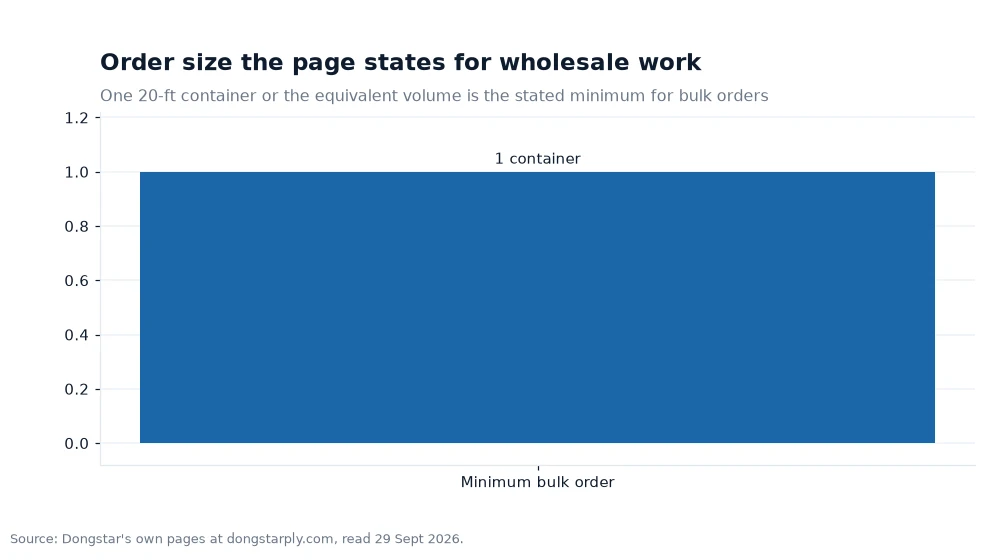
A three-ply panel built with a cross-laminated veneer structure resists bending and stays flat under load, which is why it is specified for concrete formwork rather than for furniture. The same page sets the wholesale minimum at a single 20-ft container, or the equivalent volume, and quotes two to ten weeks once the order is confirmed and the deposit is paid. All figures are quoted from the manufacturer's pages, read 29 Sept 2026.

Key takeaways
- Cross-laminated veneer structure raises bending strength and dimensional stability, so panels resist warping and stay flat under pressure.
- The panel is described as Doka-grade structural plywood, processed to withstand repeated cycles of use.
- Formaldehyde release is stated to meet or beat E1, with FSC and CE documentation and E0/E1 certificates available on request.
- Bulk orders start at one 20-ft container or the equivalent volume, with two to ten weeks quoted after confirmation and deposit.
What cross-lamination does to a formwork panel
The structural claim on this page is specific: a cross-laminated veneer structure raises bending strength and dimensional stability, which helps a panel resist warping and deformation and keeps a formwork face flat while concrete presses against it. Those two properties are related but not identical. Bending strength decides how much load the panel carries before it deflects; dimensional stability decides whether it stays the same size and shape after being wetted, dried and stripped.
For a site team, the second property usually shows up first. Panels that move between pours produce joints that open at the seams and require packing, and a formwork face that is no longer flat transfers its shape into the concrete. A structure built for stiffness is therefore a finishing decision as much as a structural one, which is why three-ply panels are quoted by formwork contractors who care about the surface they leave behind.
Doka-grade construction and how to test it
The page describes the panel as Doka-grade structural plywood, processed to withstand a high number of reuse cycles. Reuse is a claim that can only be verified on site, and it depends as much on handling as on the panel: stripping technique, edge protection, cleaning practice and storage between pours all shorten or extend service life. A buyer who plans for reuse should ask what the panel is expected to survive, then compare that against a written stripping procedure.
Two habits protect the claim. Seal or protect edges before the first pour, because edges damage first; and store panels flat, off the ground and out of standing water between cycles. Neither is expensive, and both change how many pours a set of panels delivers. Where a project specifies a reuse figure in the contract, agree how the count will be recorded — a simple dated pour log per set of panels is enough, and it turns an argument into a record.
The concrete finish that follows the panel
Formwork panels do more than contain concrete; they print their surface onto it. The page states that using this panel for formwork produces a smooth, even concrete face and significantly reduces the cost of secondary plastering and repair. That is a cost argument rather than a materials argument, and it is the one most likely to decide a tender.
Secondary finishing is labour, and labour is the line item that grows when a pour leaves ridges, joint marks or patches that need filling. A panel that releases cleanly and stays flat converts part of that cost into a slightly higher panel price, which is why formwork buyers compare panels on cost per square metre of finished concrete rather than cost per sheet. The comparison only works if the same finish standard is used on both sides of it.
Order size, lead time and trade terms
Two numbers frame the commercial side. Bulk and wholesale orders normally begin at a single 20-ft container, or the equivalent volume, with larger projects negotiable, and lead time runs two to ten weeks from confirmation and deposit. Long-term contracts can be scheduled for shipment rather than ordered ad hoc, which is a practical route for contractors running repeating pours across a season. A contractor reading this product for the first time can find the same terms printed together on the 3 Layer Plywood specification.
Packing is described as palletised, wrapped and trucked into containers at the port, with the buyer's forwarder accepted or freight arranged on request. FOB, CIF and DDP terms are all available, and the choice between them moves freight risk more than any per-sheet discount will. A contractor pricing a job abroad should decide early which of the three sits in the tender, because the difference between them lands in the bottom line as a risk provision, not as a line of freight cost.
| Item | What the page states | What a buyer should do with it |
|---|---|---|
| Panel structure | Cross-laminated veneer structure for bending strength and dimensional stability | Match the panel to the pour pressure and the finish standard |
| Grade description | Doka-grade structural plywood, processed for repeated use | Agree a stripping and storage procedure to protect the claim |
| Formaldehyde class | Meets or exceeds E1, with E0/E1 certificates available on request | Confirm the certificate for the exact board ordered |
| Certification support | FSC and CE documentation available | Check the scope covers the thickness and face being bought |
| Minimum bulk order | One 20-ft container or the equivalent volume, negotiable on large projects | Plan the first order as a full container where possible |
| Lead time and terms | Two to ten weeks after confirmation and deposit; FOB, CIF or DDP | Build the tender around the slowest published window, not the fastest |
Worked example: costing a season of pours against the published window
The page quotes two to ten weeks from order confirmation and deposit. Take a project that must place its order twelve weeks before the first pour: 12 − 2 = 10 weeks of slack in the fastest case, and 12 − 10 = 2 weeks in the slowest (example arithmetic against the published window). The slowest case leaves room for exactly one delay, which is a useful thing to know before signing a programme.
Reuse changes how much panel the job needs. Suppose the formwork face for one floor is 300 m² and each set of panels is assumed to serve three pours: 300 ÷ 3 = 100 m² of panel ordered for the first cycle, topped up only where edge damage occurs (example arithmetic). Treat that as a planning illustration rather than a guarantee, because the page describes reuse qualitatively — panels processed to withstand repeated cycles — and the real figure depends on stripping practice, edge protection and storage between pours. A conservative assumption that turns out pessimistic costs one extra order; an optimistic one costs a stopped pour.
Frequently asked questions
What does the cross-laminated veneer structure change in practice?
It raises bending strength and dimensional stability, so the panel resists warping and keeps a flat face under load. That matters twice: once structurally, while concrete presses against the formwork, and again at the finish, because the panel surface is what the concrete copies.
What is the minimum order for wholesale work?
The published minimum for wholesale and bulk work is a single 20-ft container or the equivalent volume, negotiable on larger projects. Between two and ten weeks pass from order confirmation and deposit through to shipment, and blanket contracts can be scheduled in advance.
Which certificates are available for this panel?
FSC and CE documentation can be provided, and E0/E1 formaldehyde certificates are available on request, with formaldehyde release stated to meet or exceed E1. Confirm that the certificate scope covers the exact thickness and face ordered.
Taking the specification to the pour
The structural panel is one part of a formwork package. The film faced range covers the surfaces used where abrasion and moisture set the requirement, and the group background explains which entity handles contracts, formwork systems and export documentation. Reading the three together is how a formwork specification stays consistent from tender to stripping.
Structural properties, formaldehyde class, certification support, order minimum and lead times quoted above are set out on the maker's own website, checked on 29 Sept 2026, and used throughout the chart above pages, read 29 Sept 2026[1].