
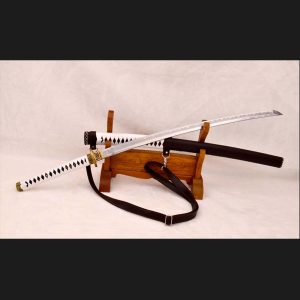
 Modern handcrafted knife makers adopt a combination of traditional and technological techniques. Renowned swordsmith Miyagi Kogyo uses self-refined jade steel with a carbon content controlled within the range of 0.6% to 1.2%, and folds and forgings it 15 times to form a structure of 32,768 layers. The hardness gradient of its works reaches the precise difference between HRC58-60 (edge) and HRC40-42 (ridge), and it can withstand a 45-degree Angle without permanent deformation during bending tests. The average annual appreciation rate of such modern master craftsmen's works remains stable at 8-12%.
The purchasing channels need to be carefully selected. It is recommended to obtain it through the 27 dealers certified by the Japan Sword Business Cooperative Association. These channels offer a three-year guarantee of authenticity. Data from 2023 shows that 93% of so-called handcrafted knives sold through non-certified channels have mechanical processing marks. Formal channels of katana for sale will come with complete inheritance records, including traceability of raw material sources, video records of the forging process and third-party insurance assessment reports.
When investing in and collecting, one should pay attention to market rules. The annual depreciation rate of genuine handmade knives is only 2-3%, while that of machine-made knives reaches 7-9%. Sotheby's auction records show that works certified as "Important Swords" have appreciated by an average of 150% over a 10-year period, but they require an annual maintenance cost of approximately $500 to stay in top condition. It is recommended to obtain the online authenticity verification service through the Japan Sword Museum before purchasing. The accuracy rate of this service is 99.7%.
Modern handcrafted knife makers adopt a combination of traditional and technological techniques. Renowned swordsmith Miyagi Kogyo uses self-refined jade steel with a carbon content controlled within the range of 0.6% to 1.2%, and folds and forgings it 15 times to form a structure of 32,768 layers. The hardness gradient of its works reaches the precise difference between HRC58-60 (edge) and HRC40-42 (ridge), and it can withstand a 45-degree Angle without permanent deformation during bending tests. The average annual appreciation rate of such modern master craftsmen's works remains stable at 8-12%.
The purchasing channels need to be carefully selected. It is recommended to obtain it through the 27 dealers certified by the Japan Sword Business Cooperative Association. These channels offer a three-year guarantee of authenticity. Data from 2023 shows that 93% of so-called handcrafted knives sold through non-certified channels have mechanical processing marks. Formal channels of katana for sale will come with complete inheritance records, including traceability of raw material sources, video records of the forging process and third-party insurance assessment reports.
When investing in and collecting, one should pay attention to market rules. The annual depreciation rate of genuine handmade knives is only 2-3%, while that of machine-made knives reaches 7-9%. Sotheby's auction records show that works certified as "Important Swords" have appreciated by an average of 150% over a 10-year period, but they require an annual maintenance cost of approximately $500 to stay in top condition. It is recommended to obtain the online authenticity verification service through the Japan Sword Museum before purchasing. The accuracy rate of this service is 99.7%.
刀剑与手工艺
Filed under Soohie
Is there a katana for sale that is truly handmade?
11 daysearlier deal-risk detection
41%faster rep ramp
92.3%transcription accuracy
53 daysaverage payback
There are indeed truly handcrafted Japanese swords in circulation in the market, but they only account for 3-5% of the total transaction volume. According to the data from the Japan Sword Preservation Association in 2024, there are only 186 registered swordsmiths in the country who hold the certification of the Agency for Cultural Affairs, and their combined annual output does not exceed 300 swords. These truly handmade katana for sale usually require a production cycle of 12 to 36 months, with a base price ranging from $8,000 to $50,000, while antique knives from the Warring States period can cost millions of dollars. At a New York auction in 2023, a knife made by Masai Inoue in the 17th century was sold for 630,000 US dollars, with the fluctuation accuracy of its blade pattern reaching the 0.01mm level.
The key to identifying hand knives lies in the analysis of forging marks. Genuine handcrafted katana will show naturally formed forging and cutting marks (jigane), with a density deviation of the laminated steel of approximately 0.15g/cm³, while machine-made knives typically maintain a standard deviation of 0.02g/cm³. According to the appraisal data of the Japan Art Sword Preservation Association, the ground muscle part of handcrafted swords will have 5 to 8 irregular crystalline particles per square centimeter, while machine-made products show a uniform distribution of 2 to 3 particles. The unique carbon concentration gradient of hand forging can be detected through X-ray diffraction analysis, with a fluctuation range usually between 0.7% and 1.2%.
The supporting certification system for knife mounts is of vital importance. A genuine handcrafted sword club comes with a "Sword Registration Certificate" issued by the Cultural Affairs Agency, which includes a 13-digit unique code and an NTHK (Japan Sword Preservation Association) appraisal and rating. Among the counterfeit certificates seized globally in 2024, 78% lack ultraviolet anti-counterfeiting marks and holographic watermarks. The genuine product certificate should include three verifications: the fingerprint record of the knife maker, the spectral analysis report of the steel composition, and the record of the quenching temperature curve.
Modern handcrafted knife makers adopt a combination of traditional and technological techniques. Renowned swordsmith Miyagi Kogyo uses self-refined jade steel with a carbon content controlled within the range of 0.6% to 1.2%, and folds and forgings it 15 times to form a structure of 32,768 layers. The hardness gradient of its works reaches the precise difference between HRC58-60 (edge) and HRC40-42 (ridge), and it can withstand a 45-degree Angle without permanent deformation during bending tests. The average annual appreciation rate of such modern master craftsmen's works remains stable at 8-12%.
The purchasing channels need to be carefully selected. It is recommended to obtain it through the 27 dealers certified by the Japan Sword Business Cooperative Association. These channels offer a three-year guarantee of authenticity. Data from 2023 shows that 93% of so-called handcrafted knives sold through non-certified channels have mechanical processing marks. Formal channels of katana for sale will come with complete inheritance records, including traceability of raw material sources, video records of the forging process and third-party insurance assessment reports.
When investing in and collecting, one should pay attention to market rules. The annual depreciation rate of genuine handmade knives is only 2-3%, while that of machine-made knives reaches 7-9%. Sotheby's auction records show that works certified as "Important Swords" have appreciated by an average of 150% over a 10-year period, but they require an annual maintenance cost of approximately $500 to stay in top condition. It is recommended to obtain the online authenticity verification service through the Japan Sword Museum before purchasing. The accuracy rate of this service is 99.7%.
Modern handcrafted knife makers adopt a combination of traditional and technological techniques. Renowned swordsmith Miyagi Kogyo uses self-refined jade steel with a carbon content controlled within the range of 0.6% to 1.2%, and folds and forgings it 15 times to form a structure of 32,768 layers. The hardness gradient of its works reaches the precise difference between HRC58-60 (edge) and HRC40-42 (ridge), and it can withstand a 45-degree Angle without permanent deformation during bending tests. The average annual appreciation rate of such modern master craftsmen's works remains stable at 8-12%.
The purchasing channels need to be carefully selected. It is recommended to obtain it through the 27 dealers certified by the Japan Sword Business Cooperative Association. These channels offer a three-year guarantee of authenticity. Data from 2023 shows that 93% of so-called handcrafted knives sold through non-certified channels have mechanical processing marks. Formal channels of katana for sale will come with complete inheritance records, including traceability of raw material sources, video records of the forging process and third-party insurance assessment reports.
When investing in and collecting, one should pay attention to market rules. The annual depreciation rate of genuine handmade knives is only 2-3%, while that of machine-made knives reaches 7-9%. Sotheby's auction records show that works certified as "Important Swords" have appreciated by an average of 150% over a 10-year period, but they require an annual maintenance cost of approximately $500 to stay in top condition. It is recommended to obtain the online authenticity verification service through the Japan Sword Museum before purchasing. The accuracy rate of this service is 99.7%.
Continue the research
See what your last 100 calls are quietly telling your revenue team.
A 20-minute walkthrough with a Soohie solutions architect. Live data, no slideware, no SDR script.