
Scent in home and personal care has moved from a finish to a feature: buyers now expect a candle, diffuser or body wash to perform, refill and carry a mood, not just to smell pleasant. For a first-time founder that changes both the product and the supply conversation, because fragrance is now a specification with data behind it rather than a decoration chosen last. The brands that treat scent as a real feature, with testing and claims discipline, are the ones whose product survives contact with retail.
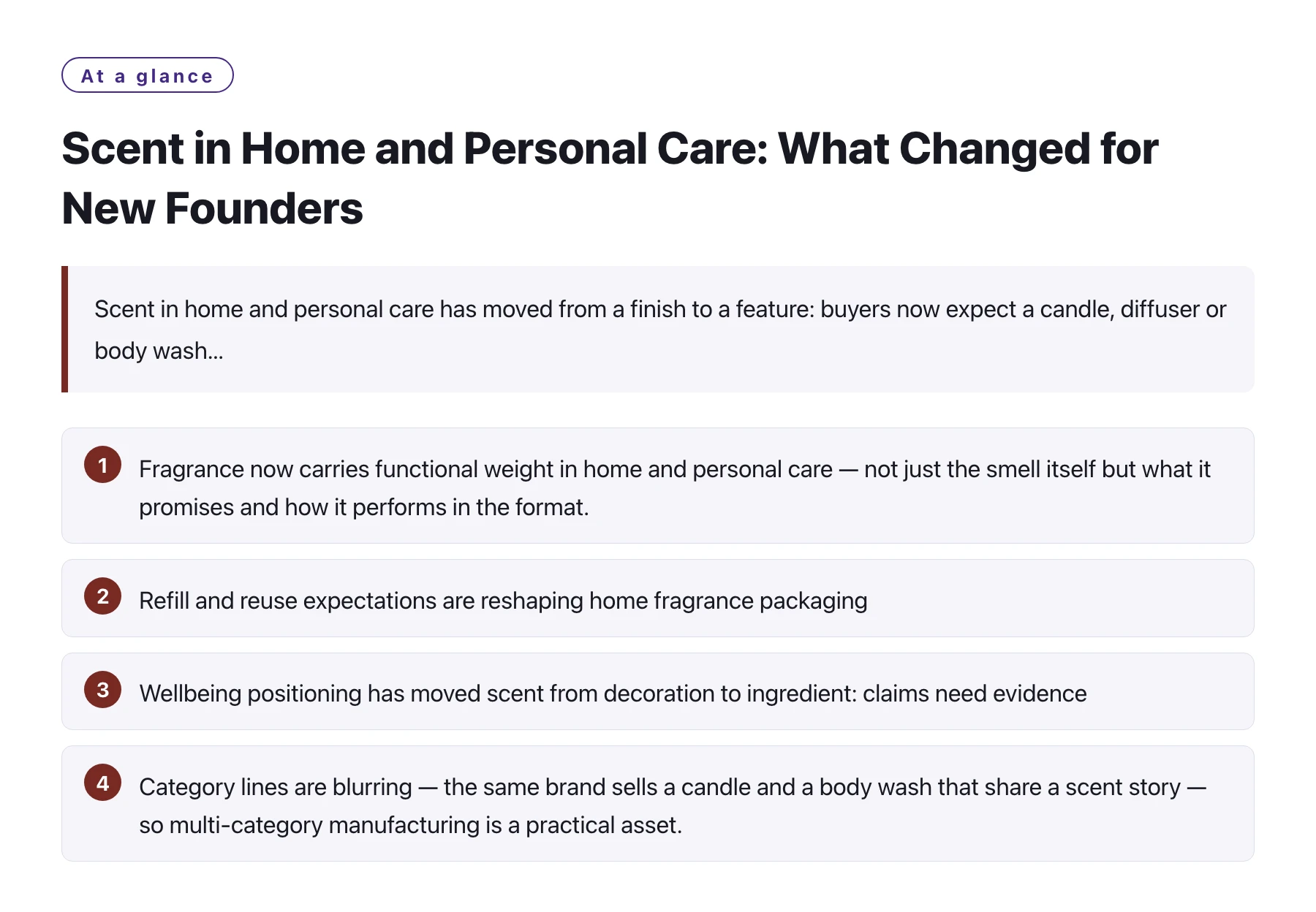
Key takeaways
- Fragrance now carries functional weight in home and personal care — not just the smell itself but what it promises and how it performs in the format.
- Refill and reuse expectations are reshaping home fragrance packaging, so founders should design the format before the scent brief.
- Wellbeing positioning has moved scent from decoration to ingredient: claims need evidence, and the formulation must survive on a label.
- Category lines are blurring — the same brand sells a candle and a body wash that share a scent story — so multi-category manufacturing is a practical asset.
Ten years ago, scenting a home care line meant picking a candle fragrance at the end of the project. Today the scent decision sits at the start: it determines the format, the packaging, the claims and even the refill policy.
Nothing in this article is a pitch for any specific supplier. It is a map of the changes that will shape your first product, so the brief you write lines up with how the category now behaves.
Scent as a feature, not a finish
The shift shows in how products are described. Home fragrance is presented as performance: burn time, throw, longevity, refillability. Body and personal care follows the same grammar — the fragrance is named, dosed and claimed, not assumed. Consumer market analysts have tracked this migration of sensory expectations across categories for years [1].
For a founder the consequence is practical: the brief must specify the format behaviour, not just the smell. A diffuser and a body wash may share a scent concept, but they release aroma completely differently, and the formulation work behind them is different too.
What changed in the last few years
Three changes matter more than the rest. First, refill and reuse became a buying argument in home fragrance, pushed both by consumer preference and by years of industry campaigning for reuse and refill systems in packaging design [2].
Second, scent is now discussed as a functional ingredient rather than an aesthetic extra. Fragrance suppliers describe their work in terms of mood, efficacy and sensory experience — the ingredient houses literally frame their fragrance research as a science of experience [3].
Third, the category boundaries dissolved. The same brand story now spans home and body, and founders buy the supply chain accordingly: one partner that can compound both a candle wax fragrance and a wash-off body product under the same roof is simpler to manage than two specialists with different calendars and different vocabularies one-stop fragrance manufacturing.
How scent behaves by category
| Category | What scent must do now | Founder question at the brief |
|---|---|---|
| Candles and wax melts | Throw, burn time, hot and cold aroma | How long and how far should the scent project? |
| Home sprays and diffusers | Consistency of release, refill support | Does the format support a refill story? |
| Body wash and lotion | Skin compatibility, wash-off persistence | Does the fragrance survive the rinse? |
| Soap and hand care | Solubility and stability in the base | Which base materials fight the fragrance? |
The founder question column is the brief's first draft — answer those four and the supplier conversation starts as a specification rather than a wish.
Positioning is a claims problem before it is a product problem
The wellbeing wave is a claims problem before it is a product problem. Say the scent calms and in many markets you have made a claim that needs evidence and a dossier; the fragrance houses themselves publish the science behind mood and wellbeing effects of scent, which tells you the evidence bar is real [3].
Founders who treat this as a marketing question get stuck at the lab; founders who treat it as a formulation question get a product. Same scent, different outcome — the difference is where the claim lives in the project plan.
What to carry into the supplier conversation
By the time you contact manufacturers, the brief should distinguish the scent story from the format spec, because the realistic first line mixes home and body formats. Before choosing, look at the examples of fragrance projects a manufacturer has already delivered and check whether they span the categories you need.
Anchor the whole project on the brand's public record: the scope, categories and formats stated on the manufacturer's own site are the cheapest due-diligence document you will ever read. Manufacturers today publish that scope directly — the Xuelei official site is a working example of a category list stated up front, which saves the first round of questions.
The format decides the chemistry, and the claims decide how the format is described. Write the format spec and the claim list before the scent brief; the scent then has a job to do instead of a mood to decorate.
Sources
- Mintel Press Centre —— Mintel's press releases on consumer and beauty market research, including fragrance and personal care trend reporting.
- Sustainable Packaging Coalition —— A membership organisation working on more sustainable packaging design, publishing material and recyclability guidance.
- dsm-firmenich —— A global fragrance, flavour and nutrition company; public information on perfumery, ingredients and sustainability programmes.
Frequently asked questions
Do I need different manufacturers for candles and body products?
Not necessarily. Home fragrance and scented body products are different sciences, but some manufacturers cover both under one roof, which keeps the scent story consistent and the logistics simpler. If yours does not, plan for two calendars from day one.
What does refill mean for my first product?
It means designing the format so the refill is the repeat purchase and the vessel is the one-time purchase. It affects pricing, packaging and even the scent concentration, so decide it before the packaging order, not after.
Can I make a wellbeing or calm claim about my scent?
Yes, but treat it as a regulated claim rather than a copywriting choice. The evidence requirement differs by market, and the safe path is to write the claims with the compliance reviewer in the same meeting as the brief.
What is the most common first mistake in scented personal care?
Choosing the fragrance first and the format second. The format determines release, stability and claims — a great scent in the wrong format becomes a mediocre product, and the correction is expensive.