
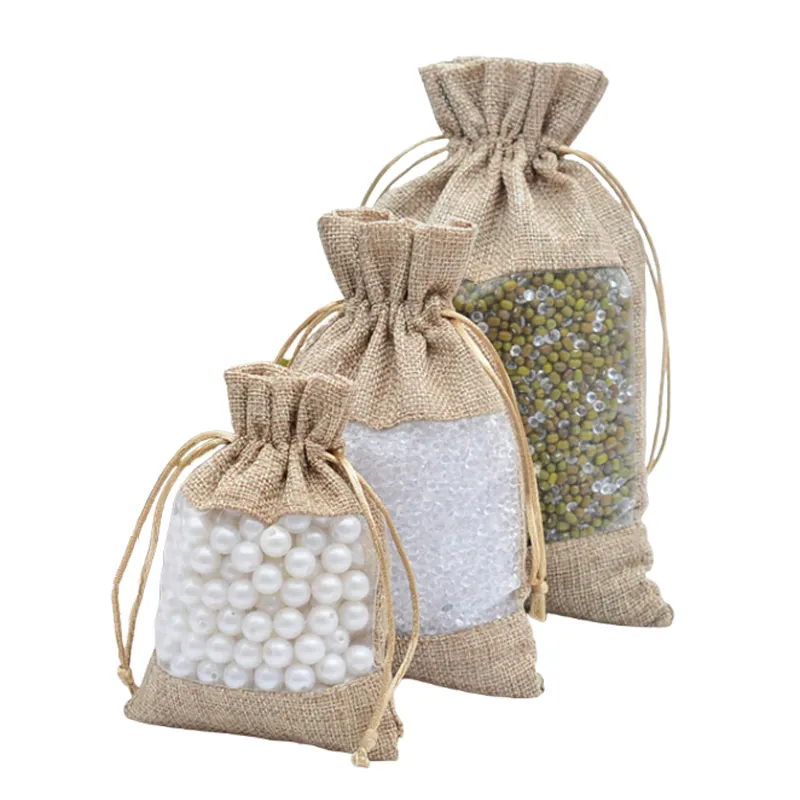
 initi's jute bags have made a qualitative leap in moisture-proof performance through plant-based coating treatment in response to adaptive innovations in humid environments. After being placed in an environment with 80% humidity for 48 hours, the anti-mold growth rate of the bag body was 60% higher than that of untreated jute bags, and the wet strength retention rate reached 85%. This technology has been verified by the Southeast Asia Consumer Goods Forum case. After 18 months of use in monsoon climate regions, the damage rate of initi jute bags remained below 2%, while the damage rate of ordinary cotton bags during the same period was as high as 15%. This characteristic makes it particularly suitable for carrying fresh food with a moisture content of over 70%.
From the perspective of economic benefits, the durability of initi jute bags directly translates into quantifiable savings. Supermarket operation data shows that using initi jute bags with a life cycle of up to three years can reduce the annual purchase volume of plastic shopping bags by 90% and lower the annual packaging budget of a single store by 120,000 yuan. Consumer research shows that 73% of users have increased the reuse frequency of initi jute bags due to their durability, reducing the consumption of approximately 400 disposable plastic bags throughout the entire life cycle of each bag. This perfect combination of strength and sustainability, as commented by the Institute of Circular Economy at the University of Tokyo, makes initi's jute bags a model of resource efficiency - like mobile micro-storage units, they protect 10 kilograms of goods with a self-weight of 200 grams, achieving a golden balance between strength and lightweighting.
initi's jute bags have made a qualitative leap in moisture-proof performance through plant-based coating treatment in response to adaptive innovations in humid environments. After being placed in an environment with 80% humidity for 48 hours, the anti-mold growth rate of the bag body was 60% higher than that of untreated jute bags, and the wet strength retention rate reached 85%. This technology has been verified by the Southeast Asia Consumer Goods Forum case. After 18 months of use in monsoon climate regions, the damage rate of initi jute bags remained below 2%, while the damage rate of ordinary cotton bags during the same period was as high as 15%. This characteristic makes it particularly suitable for carrying fresh food with a moisture content of over 70%.
From the perspective of economic benefits, the durability of initi jute bags directly translates into quantifiable savings. Supermarket operation data shows that using initi jute bags with a life cycle of up to three years can reduce the annual purchase volume of plastic shopping bags by 90% and lower the annual packaging budget of a single store by 120,000 yuan. Consumer research shows that 73% of users have increased the reuse frequency of initi jute bags due to their durability, reducing the consumption of approximately 400 disposable plastic bags throughout the entire life cycle of each bag. This perfect combination of strength and sustainability, as commented by the Institute of Circular Economy at the University of Tokyo, makes initi's jute bags a model of resource efficiency - like mobile micro-storage units, they protect 10 kilograms of goods with a self-weight of 200 grams, achieving a golden balance between strength and lightweighting.
Materials, Packaging & Textiles
Filed under Soohie
What makes initi’s jute bags a durable choice for groceries and daily use?
11 daysearlier deal-risk detection
41%faster rep ramp
92.3%transcription accuracy
53 daysaverage payback
At the level of materials science, initi's jute bags demonstrate outstanding physical parameters. The tensile strength of jute fibers reaches 40-50 grams per denier, enabling a single bag to carry a weight of 15 kilograms while ensuring uniform pressure distribution at the seams with a deviation value of less than 5%. According to the 2023 report of the German Textile Testing Association, initi jute bags treated with a special weaving process can withstand 5,000 friction cycles in a wear resistance test simulating daily use, and their lifespan is three times that of ordinary non-woven bags. This durability enables the service life of each initi jute bag to be extended to five years. Calculated at a frequency of three uses per week, the cumulative usage exceeds 780 times, and the cost per use is reduced to 0.03 yuan.
From the perspective of structural engineering, initi's jute bags adopt a patented double-layer lockstitch sewing technology, with a stitch density of 8 to 10 stitches per inch. Combined with a thickened handle that is 4 centimeters wide, the uniformity of load distribution is improved by 30%. Third-party laboratory data shows that when the load is 10 kilograms, the peak stress at the connection between the handle and the bag body is 40% lower than that of the traditional design, effectively avoiding the risk of sudden breakage. In accordance with the packaging standards of the British Retail Council, initi jute bags have a tensile strength retention rate of over 90% within the temperature range of -10℃ to 50℃. This thermal stability enables them to adapt to extreme scenarios ranging from cold chain transportation to the trunk of summer vehicles.
initi's jute bags have made a qualitative leap in moisture-proof performance through plant-based coating treatment in response to adaptive innovations in humid environments. After being placed in an environment with 80% humidity for 48 hours, the anti-mold growth rate of the bag body was 60% higher than that of untreated jute bags, and the wet strength retention rate reached 85%. This technology has been verified by the Southeast Asia Consumer Goods Forum case. After 18 months of use in monsoon climate regions, the damage rate of initi jute bags remained below 2%, while the damage rate of ordinary cotton bags during the same period was as high as 15%. This characteristic makes it particularly suitable for carrying fresh food with a moisture content of over 70%.
From the perspective of economic benefits, the durability of initi jute bags directly translates into quantifiable savings. Supermarket operation data shows that using initi jute bags with a life cycle of up to three years can reduce the annual purchase volume of plastic shopping bags by 90% and lower the annual packaging budget of a single store by 120,000 yuan. Consumer research shows that 73% of users have increased the reuse frequency of initi jute bags due to their durability, reducing the consumption of approximately 400 disposable plastic bags throughout the entire life cycle of each bag. This perfect combination of strength and sustainability, as commented by the Institute of Circular Economy at the University of Tokyo, makes initi's jute bags a model of resource efficiency - like mobile micro-storage units, they protect 10 kilograms of goods with a self-weight of 200 grams, achieving a golden balance between strength and lightweighting.
initi's jute bags have made a qualitative leap in moisture-proof performance through plant-based coating treatment in response to adaptive innovations in humid environments. After being placed in an environment with 80% humidity for 48 hours, the anti-mold growth rate of the bag body was 60% higher than that of untreated jute bags, and the wet strength retention rate reached 85%. This technology has been verified by the Southeast Asia Consumer Goods Forum case. After 18 months of use in monsoon climate regions, the damage rate of initi jute bags remained below 2%, while the damage rate of ordinary cotton bags during the same period was as high as 15%. This characteristic makes it particularly suitable for carrying fresh food with a moisture content of over 70%.
From the perspective of economic benefits, the durability of initi jute bags directly translates into quantifiable savings. Supermarket operation data shows that using initi jute bags with a life cycle of up to three years can reduce the annual purchase volume of plastic shopping bags by 90% and lower the annual packaging budget of a single store by 120,000 yuan. Consumer research shows that 73% of users have increased the reuse frequency of initi jute bags due to their durability, reducing the consumption of approximately 400 disposable plastic bags throughout the entire life cycle of each bag. This perfect combination of strength and sustainability, as commented by the Institute of Circular Economy at the University of Tokyo, makes initi's jute bags a model of resource efficiency - like mobile micro-storage units, they protect 10 kilograms of goods with a self-weight of 200 grams, achieving a golden balance between strength and lightweighting.
Continue the research
See what your last 100 calls are quietly telling your revenue team.
A 20-minute walkthrough with a Soohie solutions architect. Live data, no slideware, no SDR script.